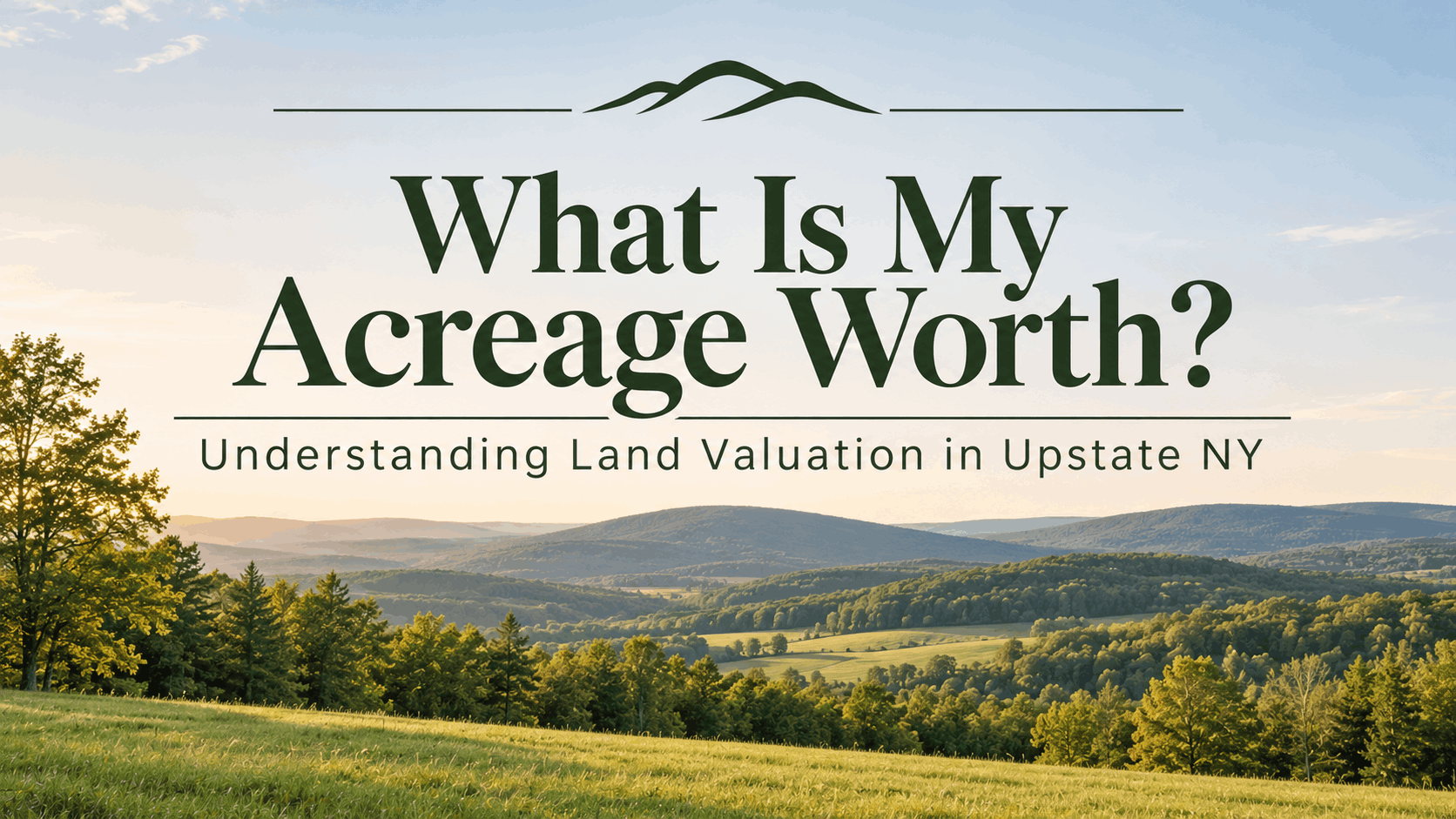
What Is My Acreage Worth? Understanding Land Valuation in NY
Have you ever looked out over your property and wondered how much your land might actually be worth?
Whether you own a few acres of wooded countryside, an open field, a recreational hunting property, or hundreds of acres of rural land, understanding its market value can be an important first step toward making your next move.
In Upstate New York, land valuation is rarely as simple as assigning a price per acre. Two properties with the exact same acreage can have considerably different values depending on their location, terrain, accessibility, natural features, and potential uses.
From the rolling hills of Otsego County to the wooded landscapes of Delaware County and the agricultural communities throughout Central New York, every property has its own characteristics that influence what buyers may be willing to pay.
So, how do you determine what your acreage is worth?
Let's take a closer look at the factors that influence land values in Upstate NY and what property owners should understand before putting their land on the market.
1. Location Plays a Major Role in Land Value
Just like residential real estate, location is one of the most important factors in determining a property's value.
In Upstate New York, buyer demand can vary significantly from one town or county to another. Some buyers are searching for recreational properties near popular outdoor destinations, while others want convenient access to established communities, schools, employment centers, and everyday amenities.
For example, acreage near Cooperstown may attract buyers interested in a countryside getaway or a future homesite. Properties around Oneonta, Delhi, and Norwich may appeal to buyers looking for rural living with reasonable access to local services.
When evaluating your property's location, consider:
-
Proximity to towns and amenities: How far is the property from shopping, schools, healthcare, and other services?
-
Nearby attractions: Is it close to lakes, hiking trails, ski areas, parks, or popular recreational destinations?
-
Neighborhood characteristics: Is the surrounding area primarily agricultural, residential, recreational, or commercial?
-
Buyer demand: Are people actively searching for land in your particular community?
A secluded property may be especially appealing to someone looking for privacy, while another buyer may prioritize convenience and accessibility.
Understanding the local market helps determine which buyers are most likely to be interested in your property.
2. The Number of Acres Isn't the Whole Story
One of the most common misconceptions about land valuation is that more acreage automatically means a higher price per acre.
While total acreage certainly matters, the actual characteristics and usability of the land can be just as important.
Consider two properties, each offering 20 acres.
One property features several acres of level, open ground, a wooded section, and plenty of room for a potential homesite. The other consists mostly of steep hillsides, wetlands, and rocky terrain.
Although both properties have the same acreage, their potential uses and appeal to buyers may be very different.
Some things that influence land usability include:
-
Topography: Is the property level, gently rolling, or steep?
-
Cleared acreage: Are there open fields suitable for farming, livestock, gardening, or building?
-
Wooded acreage: Does the property contain mature hardwoods, evergreens, or mixed forest?
-
Wetlands and water features: Are there streams, ponds, springs, or environmentally protected areas?
-
Buildable areas: Are there suitable locations for a home, cabin, or other structures?
A property with a desirable combination of open fields, wooded areas, and accessible terrain may appeal to several different types of buyers.
The important thing to remember is that land value isn't determined by acreage alone. It's also about what the property can realistically offer.
3. Road Frontage and Accessibility Matter
A property may have beautiful views, mature trees, and plenty of acreage, but buyers still need a practical way to access it.
Road frontage is an important consideration when evaluating vacant land throughout Upstate NY.
A parcel with substantial frontage along a paved, town-maintained road may offer advantages over a property that relies entirely on a private road or deeded right-of-way.
Buyers often consider:
-
How many feet of road frontage does the property have?
-
Is the road publicly maintained?
-
Is access available throughout the year?
-
Is there an existing driveway or established entrance?
-
Are there shared access agreements or deeded easements?
Accessibility is particularly important for buyers interested in building a home, establishing a camp, or using the property for recreational purposes.
It's also worth understanding that road frontage does not automatically guarantee the right to build or subdivide. Local zoning, driveway permits, and other requirements still need to be considered.
4. Utilities and Building Potential Can Influence Value
For buyers interested in building, the availability of utilities can make a significant difference.
A parcel with electric service already available, an existing well, or an established septic system may be attractive to someone hoping to develop the property without starting entirely from scratch.
However, land without utilities can still have considerable appeal, especially among buyers interested in off-grid living, hunting camps, recreational retreats, or long-term land ownership.
Here are some important considerations:
Electricity: Is electric service already connected, or is power available nearby?
Water: Does the property have an existing well, spring, or other potential water source?
Septic: Has the property undergone a soil evaluation or septic feasibility assessment?
Internet: Are reliable internet services available in the area?
Zoning: What types of buildings and property uses are permitted by the municipality?
Development potential: Could the property potentially accommodate a home, cabin, agricultural operation, or additional structures?
Keep in mind that a property that looks suitable for building isn't necessarily a legally approved building lot. Buyers should verify zoning, septic suitability, wetlands, access, and other applicable requirements before making development plans.
The more information available about a property's potential uses, the easier it may be for buyers to evaluate its possibilities.
5. Natural Features Can Make Your Property More Desirable
One of the wonderful things about owning land in Upstate New York is the variety of natural features that make each property unique.
For some buyers, the appeal of a property goes beyond its acreage. It's about the lifestyle, recreational opportunities, and natural surroundings it provides.
Certain features may help make your land stand out in the market.
Timber and Mature Trees
Wooded properties containing mature hardwoods such as maple, oak, and cherry may attract buyers interested in timber resources. Depending on the species, quality, volume, accessibility, and harvesting conditions, timber may have additional economic value. A professional timber evaluation can help establish its potential.
Water Features
Natural springs, streams, ponds, and other water features can add to a property's recreational appeal. They may also provide attractive natural surroundings for buyers looking for a private getaway.
Scenic Views
Rolling hills, open valleys, mountain views, and beautiful countryside landscapes are features that many rural property buyers appreciate.
Wildlife and Recreational Opportunities
Properties with established trails, hunting areas, wildlife habitat, and wooded surroundings may be especially attractive to outdoor enthusiasts.
These features don't necessarily translate into a fixed dollar amount, but they can help differentiate your property from other available acreage and attract buyers looking for something specific.
6. Comparable Land Sales Help Establish Market Value
So, how do real estate professionals determine what a particular piece of land is worth?
One of the most useful methods is reviewing comparable property sales, commonly called comps.
A comparative market analysis examines recently sold properties with similar characteristics to help estimate what buyers may be willing to pay for your land.
For example, if you own 25 acres in Otsego County, an agent may research recent sales of other parcels in the surrounding area with comparable acreage, road frontage, terrain, accessibility, and potential uses.
However, finding truly comparable land isn't always straightforward.
Unlike residential homes, vacant land can have significant differences even when properties are located in the same town.
A meaningful comparison should consider:
-
Location and surrounding market
-
Total acreage and parcel configuration
-
Road frontage and accessibility
-
Terrain and usable acreage
-
Utilities and building potential
-
Natural features and recreational appeal
-
Recent comparable sale prices
It's also important to distinguish between a property's asking price and its actual selling price.
A parcel listed for $150,000 doesn't automatically mean it's worth $150,000. Looking at completed transactions can provide a more realistic picture of what buyers have actually paid for similar properties.
This is where local market knowledge becomes especially valuable.
7. Zoning, Easements, and Property Restrictions Shouldn't Be Overlooked
Before determining what your acreage may be worth, it's important to understand any restrictions or regulations affecting the property.
In New York, local zoning laws and other property restrictions can influence how land may be used, developed, or divided.
Some properties may have agricultural classifications, conservation easements, deed restrictions, wetlands, or other limitations that buyers need to understand.
Important information to review includes:
-
Current property survey or boundary map
-
Deed and ownership records
-
Local zoning requirements
-
Property tax assessment and classification
-
Easements and right-of-way agreements
-
Wetland and environmental information
-
Agricultural or conservation restrictions
For instance, a large parcel may appear to have subdivision potential, but local minimum lot sizes, frontage requirements, zoning regulations, or environmental restrictions could limit the ability to divide it.
Understanding these details before listing your property can help avoid surprises during the selling process and give prospective buyers a clearer picture of what they're purchasing.
8. Market Conditions and Buyer Demand Also Affect Land Prices
Even if your property has excellent features, its market value is also influenced by what is happening in the real estate market.
Buyer demand, interest rates, economic conditions, available inventory, and seasonal activity can all influence land sales throughout Upstate New York.
Different buyers also have different reasons for purchasing acreage.
Some may be looking for:
-
A place to build their dream country home
-
A recreational property for hunting, hiking, or camping
-
Agricultural land for farming or livestock
-
A private getaway away from busy communities
-
An investment opportunity for the future
-
Additional acreage adjoining an existing property
Understanding who is actively searching for land in your area can help determine how your property should be marketed and positioned.
For example, a parcel with open fields and suitable agricultural characteristics may attract a different audience than a secluded wooded property with trails and hunting opportunities.
The right marketing approach should highlight the features that matter most to the buyers most likely to be interested.
9. Land Assessment vs. Market Value: What's the Difference?
Here's something many landowners don't realize: your property's assessed value for tax purposes isn't necessarily what it could sell for on the open market.
In New York, local assessors determine property assessments for taxation purposes. These assessments are used in calculating property taxes and may not reflect the price a buyer would currently be willing to pay.
Market value, on the other hand, is influenced by current buyer demand, comparable sales, property characteristics, and overall market conditions.
This means your acreage could potentially sell for more or less than its assessed value.
If you're thinking about selling, it's important to look beyond the number on your property tax bill and consider what comparable properties are actually selling for.
A local comparative market analysis can help provide a more current perspective.
So, What Is Your Acreage Worth in Upstate NY?
The truth is that there is no universal price per acre that applies to every property throughout Upstate New York.
A 10-acre parcel with paved road frontage, open fields, and potential building sites may have a very different market value than 10 acres of steep, landlocked woodland.
The best way to estimate your property's worth is to look at the complete picture:
-
Where is the property located?
-
How much usable acreage does it offer?
-
What kind of road access and frontage does it have?
-
Are utilities available?
-
What natural features make it unique?
-
What uses are permitted?
-
What have similar properties recently sold for?
-
What is the current demand for land in the area?
Each of these details helps tell the story of your property's potential market value.
And sometimes, the features you may overlook are exactly what a prospective buyer is searching for.
Thinking About Selling Your Land? Let's Talk About Its Potential.
Whether you own five acres, 50 acres, or several hundred, understanding your property's value is an important step toward making informed real estate decisions.
At The Land & Living Team, we understand that land is different from traditional residential real estate. Every parcel has its own characteristics, opportunities, and challenges, which is why evaluating acreage requires more than simply looking at the number of acres.
With local knowledge and an understanding of the rural real estate market throughout Upstate New York, we're here to help landowners better understand their property's market potential.
If you've been wondering what your acreage could be worth, we'd love to help you take the first step.
Your land has a story. Let's discover what it's worth.
Recent Posts